
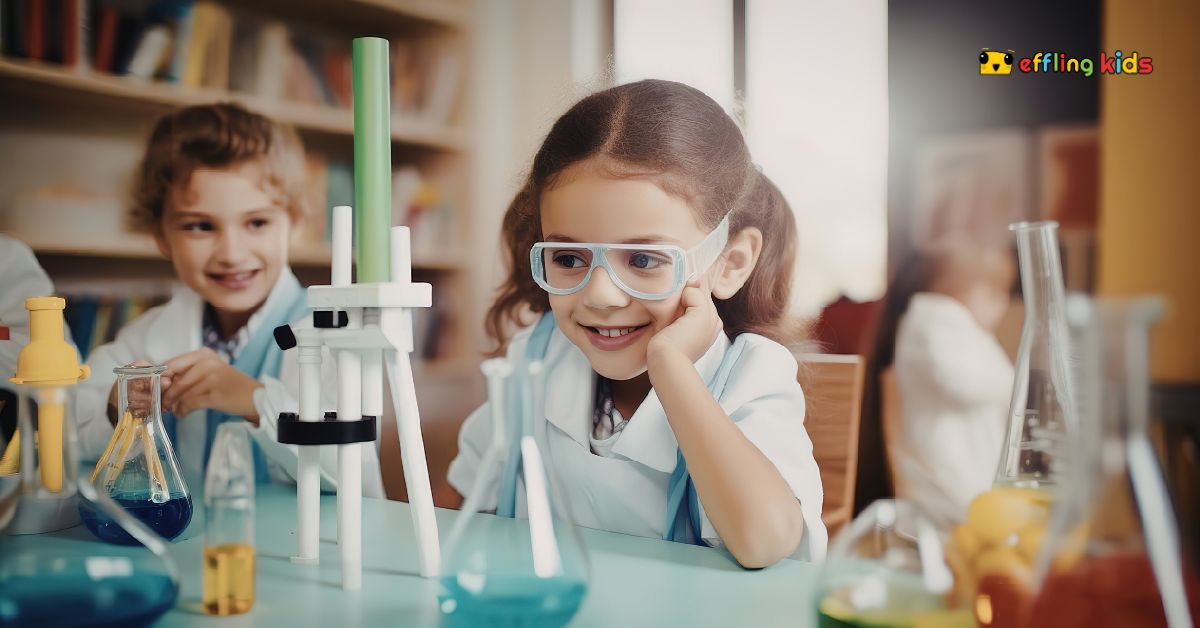
Discover 11 simple, low‑cost science experiments you can do at home with toddlers and preschoolers using everyday materials. Each activity builds curiosity, early STEM skills, and language while keeping learning playful.
Perfect for homeschooling or after‑school time, and easy to pair with Effling Kids practice sessions.
1. Sink or Float Bucket
- Fill a tub/bucket with water.
- Collect 8–10 items: spoon, leaf, crayon, small toy, coin, plastic cup, stone, etc.
- The child guesses “sink or float?” then drops and observes.
- Talk about “heavy and light”, “metal vs plastic”, and count how many sank/floated.
Link to Effling: later do counting or “more/less” questions in Math AI.
2. Colour‑Mixing Water Cups
- Fill three clear cups with water and add red, yellow, and blue food colour (or sketch‑pen ink).
- Child mixes small amounts in an empty cup: red+yellow, blue+yellow, red+blue, and sees new colours.
- Let them “paint” a small sheet with the mixed colours.
Link to Effling: talk about colour names in English/Hindi, then do colour activities in the app.
3. Baking Soda & Vinegar “Mini Volcano”
- In a small bowl or bottle, put 2–3 spoons of baking soda + a few drops of colouring.
- Slowly pour in vinegar → watch fizz and “eruption”.
- Ask: “What did you see? Foam, bubbles, sound?” and repeat with different colours.
Safety: do on a tray, away from eyes; no tasting.
4. Walking Water / Paper Towel Rainbow
- Place two cups: one with coloured water, one empty.
- Put a folded paper towel with each end in each cup.
- Over time, water “walks” along the towel into the empty cup and mixes colours.
- Child observes: “Why is the second cup changing colour?”
Great for patience and observation.
5. Floating vs Sinking in the Bath
- During bath time, drop a spoon, a plastic ball, soap, a leaf, small bottle cap into a bucket.
- First guess, then test: “Will this float or sink?”
- You can later introduce simple terms: “Some things are lighter than water.”
Simple to add to the daily routine.
6. Oil and Water in a Jar
- Fill a clear jar half with water, and add a little food colour.
- Pour some cooking oil on top, close the lid, shake, then keep still.
- A child watches oil separate and float above the water.
- Ask, “Do they mix or stay apart?” (introduce the idea that some liquids don’t mix).
7. Nature Scavenger Hunt (Mini STEM Walk)
- In the balcony/park, ask the child to find: one smooth leaf, one rough leaf, one round stone, something yellow, something long.
- Back home, compare sizes, textures, colours, and count the objects.
Link to Effling: later practise counting, colours, “bada–chhota” vocabulary.
8. Block / Cup Tower Challenge
- Give blocks or paper cups, ask the child to build the tallest tower they can.
- When it falls, talk about why; try a wider base next time.
- Introduces stability, balance, and simple engineering thinking.
You can also ask them to build a “bridge” between two books or stools.
9. Salt vs Sand in Water
- In one glass of water, mix salt – see it disappear; in another, add sand – see it settle.
- Let the child touch/taste a tiny bit of salty water (with care) to feel the difference.
- Explain simply: “Some things melt in water, some don’t.”
Great for early “dissolve vs not dissolve” understanding.
10. Ice Rescue
- Freeze small toys or buttons in an ice tray overnight.
- The next day, give the child a bowl of warm water and a spoon; let them “rescue” the toys by melting the ice.
- Talk about solid vs liquid, cold vs warm, and time (“It took longer when the water was cool”).
11. Five Senses Mystery Bag
- Put different objects in a bag: cotton, a coin, a lemon, an orange peel, a bell, a toy, etc.
- Child closes eyes and uses one sense at a time: touch, sound, smell (only safe items).
- Ask them to guess what it is and then check.
You can later connect to Effling with vocabulary (soft/hard, loud/quiet, rough/smooth).