
Across India, preschool and early primary education are changing fast, and so are expectations from parents and regulators.
Parents no longer feel satisfied with photos of “activities”; they want proof that their child is actually learning to read, write and understand numbers.
At the same time, the National Education Policy (NEP) 2020 and the NIPUN Bharat Mission have made foundational literacy and numeracy (FLN) in the early years the top national priority, putting more pressure on schools to show real outcomes, not just enrolment.
For many preschool owners, this raises a tough question: How do we show measurable FLN outcomes without raising fees or overloading teachers?
Why FLN pressure is rising
NEP 2020 clearly states that achieving foundational literacy and numeracy by Grade 3 is the highest priority for the school system, because without this, the rest of the curriculum does not matter.
NIPUN Bharat was launched to turn this into action, aiming for all children to reach grade-level reading and basic math proficiency in the early years through training, learning materials and monitoring.
National surveys like ASER 2024 show why this is urgent: even after some recovery, only about one‑third of Class 3 children in government schools can read a Class 2 text or do a simple subtraction, and many older students still struggle with basic arithmetic.
This has sent a clear signal to governments, boards and school owners: if children are not strong in FLN by Grade 2–3, the whole system is failing them.
Parents now ask: “What did my child actually learn?”
On the parent side, expectations have also changed.
Today’s millennial and Gen‑Z parents are used to apps that show progress, health scores, and weekly reports in other parts of life; they expect something similar from their child’s school.
When they visit a preschool, they don’t just ask about safety and infrastructure; they also ask how the school builds strong reading and math foundations, and how they can see that progress over time.
If a competing preschool shows neat learning portfolios, simple skill reports, or digital progress snapshots, and your school can only show a pile of worksheets, you lose an important edge in admissions and retention.
The challenge: outcomes without higher fees
Most preschool owners genuinely want better outcomes, but they face real constraints:
- Fees are already sensitive, especially in low‑ and middle‑income neighbourhoods.
- Teachers are overloaded with planning, classroom management and communication, so manual tracking of each child’s FLN skills is hard.
- Traditional worksheets are time‑consuming to create and correct, and do not automatically give you data on which skills each child has mastered.
As a result, even committed schools struggle to turn good teaching into clear, simple evidence that parents and regulators can understand.
A new option: a structured practice app for Nursery–UKG
This is where a structured practice app designed specifically for Nursery–UKG, like Effling Kids, can quietly do the heavy lifting in the background.
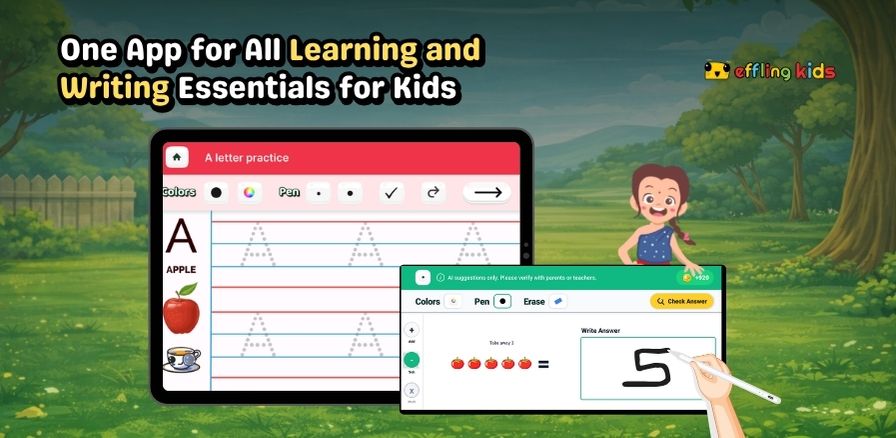
Effling is built as a safe, smart, paperless learning platform for early years, covering math, English, Hindi, counting, object recognition, writing practice and worksheets.
Instead of replacing your teachers or changing your curriculum, a practice app can act as a “practice engine” that:
- Gives each child daily, short practice sessions aligned with early FLN skills (number sense, basic operations, letter‑sound recognition, simple words).
- Checks answers instantly and adjusts difficulty so that practice feels like a game, not an exam.
- Records what the child attempted, how much time they spent, and where they needed help.
Because the app is structured around FLN competencies, every small practice session contributes to the bigger goal NEP and NIPUN Bharat talk about: strong foundations in reading and numeracy by Grade 2–3.
How Effling‑style practice works in a preschool day
A simple way to integrate this in your timetable:
- Daily 10–15 minute practice slot: During or after circle time, small groups of children rotate through devices (phones or tablets) and complete their personalised math or literacy tasks in the app.
- Teacher supervision, not extra planning: The teacher does not have to design tasks or mark every response; they just oversee, encourage and support children who need help.
- Automatic logging: The app logs how many questions each child attempted, which skills they practised (e.g., counting to 20, simple addition within 10), and their accuracy.
For Effling specifically, Math AI can automatically generate age‑appropriate tasks, check them in real time, and gently increase or decrease difficulty to keep each child in the “fun challenge” zone.
Over a month, this creates a rich, honest picture of each child’s strengths and gaps—without adding manual data entry for your staff.
Turning practice data into simple reports that parents understand
Raw data is not enough; what convinces parents is clear, simple reporting that answers two questions: Is my child on track? And what are we doing about it?
A structured practice app can help you generate:
- Monthly skill snapshots: For each child, a one‑page summary showing time spent, key skills practised (e.g., “can compare numbers up to 20”, “recognises 15 sight words”), and a simple colour code (emerging/developing / strong).
- Class‑level views: A quick view for teachers showing which FLN skills most children have mastered and where the class needs more work—very useful for planning and for internal quality reviews.
- Parent‑friendly visuals: Simple graphs or progress bars that can be shown during PTMs or shared digitally, instead of complex spreadsheets.
With Effling‑type data, you can tell a parent:
“Last month, your child spent around X minutes on number practice, confidently solved addition within 10, and is now beginning to work on word problems with pictures.”
This is far more powerful than saying, “We did many activities,” and hoping parents trust you.
How does this strengthen your position with regulators and boards
When inspectors, auditors or board members visit, they increasingly ask about learning outcomes, not just infrastructure.
By using a structured practice app aligned to FLN goals, you can show:
- That your school has a clear process for daily foundational practice.
- That you can produce evidence of progress in reading and numeracy in the foundational stage, which is exactly what NEP 2020 and NIPUN Bharat emphasise.
- That your teachers are supported with tools that help them identify struggling learners early and adjust classroom teaching accordingly.
This positions your preschool as a proactive, NEP‑aligned institution that takes FLN seriously—an advantage in a future where learning outcomes will matter more and more.
Doing all this without increasing fees
The best part is that this approach does not require you to raise fees or invest in expensive hardware:
- Most Indian preschools already have at least a few smartphones or tablets that can be dedicated to practice time.
- Effling Kids is built as an affordable, early‑years‑focused app, and its Math AI and worksheet components are designed to work even in low‑fee environments.
- Because planning, task creation, checking and logging are automated, you save on printing costs, teacher time and manual data work—resources you can re‑invest into better teaching and communication.
In other words, you convert the effort you are already spending into visible, shareable learning outcomes—without asking parents to pay more.
How Preschools Can Collaborate With Effling Kids and Support Home Learning
Strong learning outcomes come when school and home move in the same direction, not separately. Research consistently shows that when parents and teachers work together, children’s progress in the early years is faster and more stable.
Right now, we don’t ask schools to sign up through a complicated portal. Instead, we keep collaboration simple and personal:
- If you run a preschool or daycare and want to give your own parents a special Effling plan, you can contact us directly on WhatsApp or by email.
- Together, we discuss your fee structure, parent profile and learning goals, and then design a Smart Start discount for your school community – up to 50% off for your parents.
- Parents use Effling Kids at home with their child for 10–15 minutes a day, and can see their child’s practice time and progress inside the app, while you continue to use it in class as part of your FLN routine.
This way, your preschool becomes the bridge: you recommend one safe, structured app instead of random videos, and families get an affordable way to continue the same learning at home.
Let’s collaborate with us
WhatsApp: 9794783697
Email: info.effling@gmail.com
FAQs for Preschool Owners
1. Why is everyone suddenly talking about “foundational literacy and numeracy (FLN)” in early years?
Because NEP 2020 and the NIPUN Bharat Mission clearly say that every child should achieve grade‑level reading and basic math by around Grade 3, and make this the highest priority of the school system. National surveys like ASER 2024 still find many children in Classes 3–5 struggling with Class 2‑level reading and simple arithmetic, so regulators and boards are now asking schools to show real FLN outcomes, not just activities.
2. How can a preschool realistically “show outcomes” when children are so young?
You don’t need exams; you need evidence of regular, structured practice in core skills and simple records of progress. This can include teacher observations, sample work, and increasingly, data from digital tools that show time spent, skills practised, and improvement over weeks and months.
3. What exactly does Effling Kids do for FLN?
Effling Kids is an early‑years learning app for Nursery–UKG that covers math, English, Hindi, counting, object recognition, writing practice and worksheets. Its Math AI gives children short, age‑appropriate tasks, checks answers in real time, and gently adjusts difficulty so that daily practice becomes fun and low‑pressure instead of fearful.
4. How does Effling help us track and show learning outcomes?
Whenever a child practises, Effling automatically logs:
- How many questions do they attempt and for how long?
- Which skills they practised (e.g., counting, comparing numbers, simple addition).
- Their accuracy and progress over time.
These logs can be turned into simple, parent‑friendly and school‑friendly reports that show whether a child is on track with key FLN skills, exactly the kind of evidence NEP/NIPUN Bharat encourages.
5. Will this increase teacher workload?
No. The idea is the opposite: Effling handles task creation, checking and logging, so teachers can focus on explaining concepts, storytelling, activities and supporting children who struggle. Teachers mainly need to schedule short practice slots and use the app’s data to see which skills need more attention in class.
6. Do we need expensive hardware or a computer lab?
No. Effling runs on regular Android phones or tablets, which many preschools and families already use. You can start with a few shared devices in class and then encourage parents to install the app at home for continuity.
7. Is the app safe for young children?
Effling Kids is designed specifically for early childhood learning, not as an open entertainment platform. Children see age‑appropriate tasks and practice content aligned to early‑years skills, which is safer and more focused than random videos or apps not built for education.
8. How does collaboration between Effling and a preschool work right now?
We keep it simple and personal:
- You contact Effling on WhatsApp 9794783697 or by email info.effling@gmail.com with your school details.
- We understand your fee structure and parent profile.
- We create a Smart Start plan with up to 50% discount for your parents, so they can use Effling at home as well.
There is no complicated portal or long contract required to begin.
9. What do parents actually do at home with Effling Kids?
Parents download the app, log in for their child, and follow 10–15 minutes of daily practice. The app gives tasks, checks answers instantly, and shows simple progress so parents can see their child’s growth. This keeps home learning aligned with what children practise at school and strengthens the parent‑teacher partnership, which is key in early childhood education.
10. How does this partnership help my preschool stand out?
You can honestly tell parents and regulators that:
- Your school takes FLN seriously and follows NEP/NIPUN Bharat directions.
- Every child gets structured, data‑backed practice in math and early literacy.
- You provide a clear, affordable app for home practice, with up to 50% discount for your families.