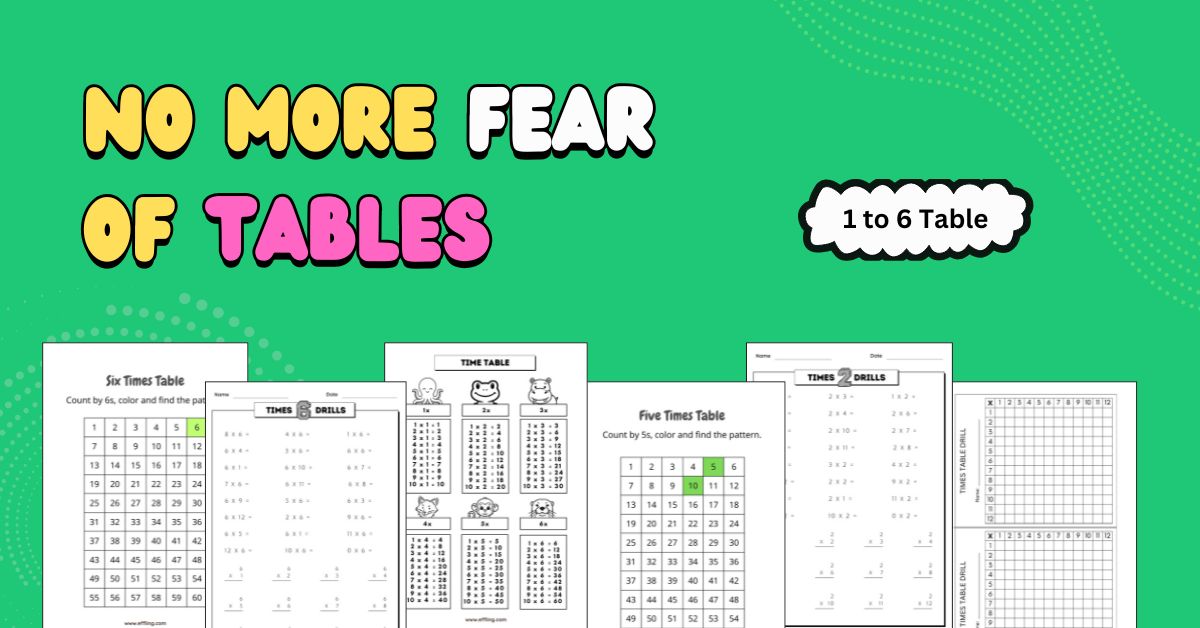
Most children struggle with multiplication tables.Not because math is hard, but because the way we teach it is. For years, kids have been told to memorize tables again and again.But memorizing without understanding often leads to fear, confusion, and forgetfulness. What if tables could be learned in a smarter, easier way? Introducing a Better Way to Learn Tables We designed these math worksheets to help children see, practice, and understand patterns, not just repeat numbers. Instead of only reading tables like:2 × 3 = 63 × 4 = 12 Children get to: What Makes These Worksheets Different 1. Practice + Writing = Better Learning Children don’t just read tables, they write them. Writing helps: When a child writes 2 × 5 = 10 multiple times,They don’t just remember it, they understand it. 2. Pattern-Based Learning (Not Just Memorizing) In worksheets like “count by 2s, 3s, 4s,” children: This builds real math understanding, not just rote memory. 3. Step-by-Step Table Drills Each page focuses on one table: Children practice: This builds confidence slowly without pressure. 4. Visual + Activity-Based Learning With grids, coloring, and patterns: Why This Matters for Early Learners Rote learning often leads to: But when children: They develop: How to Use These Worksheets Consistency matters more than speed. Final Thought Math is not about memorizing numbers.It’s about understanding patterns and building confidence. When children learn through writing and practice,they don’t just remember tables — they learn how math works. That’s the goal.

Category: Uncategorized
Nursery to UKG Fees in India: A Simple Guide for Parents
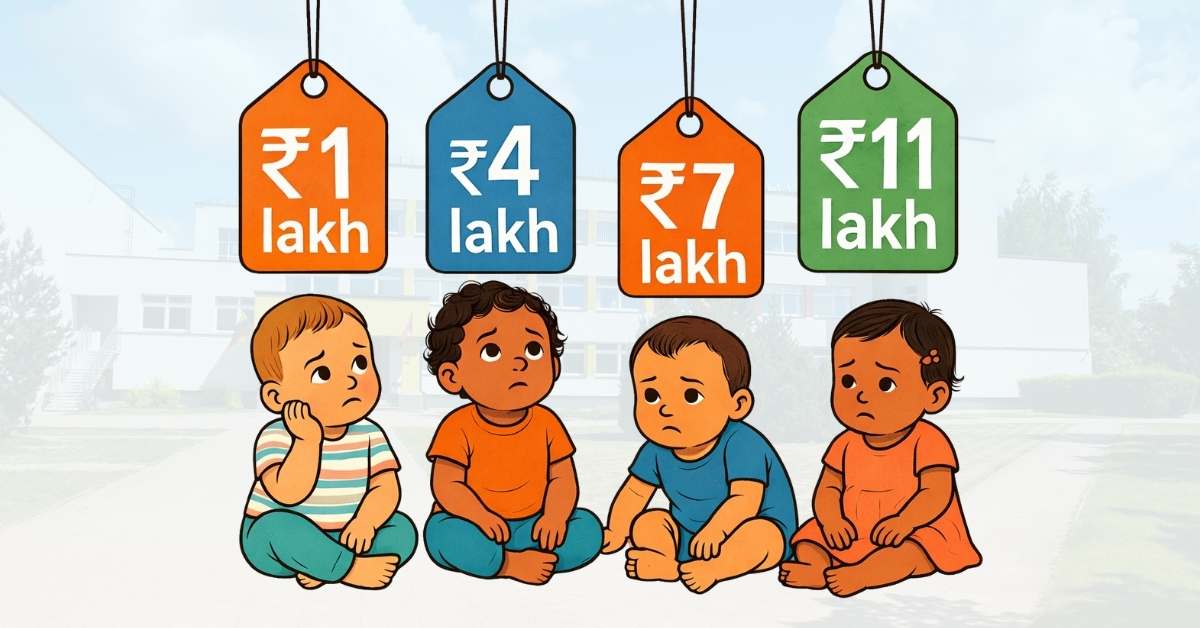
If your child is around 3 to 6 years old, you’ve probably started looking for schools. Nursery, LKG, UKG… and then suddenly, the fees. In many schools, the yearly cost can go from ₹10,000 to even ₹60,000 or more. And that’s not all. There are admission charges, books, uniforms, activity fees… slowly, it keeps adding up. For many parents, this feels heavy, especially when the child is just starting to learn basic things like A, B, C, or 1, 2, 3. It makes you think, is this really worth it at this stage? What Children Actually Learn in Nursery to UKG At this age, children are not studying difficult subjects. They are just building their base. They learn: And honestly, most of this comes from practice, not from expensive classrooms. Children learn more when they: Why Many Parents Are Rethinking This These days, many parents are gradually changing how they view early education. It’s not that school is bad. But depending only on expensive systems doesn’t always feel right. So parents try other ways also: Because at home, they can give more time and attention. But There Is Still a Problem Even these options are not perfect. Worksheets are good, but once done, you need to print again.Many apps are full of videos, but kids just watch and don’t practice much. Sometimes there is no proper flow of learning. So parents get confused, what is the right way? A Simple Way That Actually Works At this stage, learning should be simple. Children don’t need pressure. They need: When a child writes something 5–10 times, they remember it better.When they enjoy it, they don’t resist learning. That’s where things start improving naturally. A More Practical Option for Parents Effling Kids is designed to make early learning simple and practical for children from pre-nursery (toddler stage) to UKG. In the beginning, kids start with basic tracing, lines, and shapes, which helps improve hand grip and control. As they grow, they move to the alphabet, numbers, and understanding concepts step by step. With Preschool Math AI, children can practice and get real-time feedback, helping them learn from mistakes and improve with unlimited practice. Parents also stay in control through a simple panel where they can set screen time and track their child’s progress. Key highlights: It’s simple, structured, and made for how children actually learn. Let’s Talk About Cost In India, Nursery to UKG fees are not fixed and can vary a lot depending on the city and type of school. In smaller towns, some schools may charge around ₹10,000 to ₹25,000 per year. In bigger cities or private branded schools, fees can go between ₹30,000 and ₹60,000 or even higher. Along with yearly fees, many schools also take a one-time admission charge, which can range from ₹5,000 to ₹50,000. Apart from this, parents often have to pay extra for books, uniforms, activities, and sometimes daycare. Because of all these added costs, the total expense of early education can become quite high for many families, especially at a stage where children are just starting basic learning. Effling Kids App is much simpler in comparison, ₹69 per month or ₹699 per year. For many families, this feels more manageable. What Really Matters in the End In their early years, children don’t remember big buildings or fancy classrooms. They remember: And that’s what builds their base. Final Thought You don’t always need to spend a lot to give your child a good start. With a little time, the right tools, and daily practice, learning can happen very well at home, too. Every parent just wants their child to learn well and feel confident.And sometimes, simple ways work better than expensive ones. FAQs What are Nursery to UKG fees in India? Usually between ₹10,000 and ₹60,000 per year, depending on the school and city. Can I teach my child at home? Yes, many parents do it. With regular practice and simple tools, children can learn well at home. Are worksheets enough? They help, but they are limited. Kids need repeated practice and engagement. Do apps really help children learn? Some do, but many are only for watching. Practice-based tools are more useful. What is a simple and affordable option? You can combine home learning, worksheets, and tools like Effling to support your child. 👉 Start Small If you want a simple way to help your child practice daily, you can try the EfflingKids App starting at ₹69/month.
Best Handwriting App for Preschoolers in India

Let’s be honest, getting young kids in India to practise handwriting isn’t always easy. Whether it’s English letters, Hindi matras, or simple numbers, most preschoolers would rather run off to play than pick up a pencil. As parents, we understand the value of early writing skills, but making it engaging and consistent is a daily challenge. That’s exactly why Effling Kids has become a quiet revolution in many Indian homes. It’s more than just another handwriting app for preschoolers. It’s a thoughtful learning platform designed to replace stacks of expensive notebooks and countless wasted pages with fun, guided, digital practice. A New Way to Build Handwriting Skills Remember the old days? Pages full of A, B, C and अ, आ, इ… are often smudged or half-finished. Those paper worksheets don’t adapt or correct mistakes, and they definitely aren’t reusable. But with Effling Kids, your child traces letters, numbers, and even shapes right on the screen, which helps them write better each time. The app doesn’t just teach how to form letters. It builds fine motor skills, confidence, and a sense of achievement. And because it’s all digital, it saves money and trees—something more families in India are beginning to care about. Designed for Preschoolers in India Most apps today are either too flashy, too complicated, or just not made with Indian preschoolers in mind. Effling Kids changes that. It’s built specifically for children aged 3 to 7 in India, covering: ✅ Hindi & English alphabets✅ Basic numbers & early math✅ Fun art shapes for drawing practice Whether your child is learning to write their first “A” or mastering Hindi swar and vyanjan, Effling’s interactive approach makes handwriting feel like a game, not homework. Parents Love It (And Kids Do Too) What makes Effling Kids stand out is how easy it is to use. Large icons, gentle voice prompts, and colourful tracing paths keep kids interested. Meanwhile, parents can track what their child practised, how long they engaged, and where they might need more help. With most Indian parents worried about excessive screen time, Effling Kids actually turns screen time into skill time. Instead of random videos, kids practise writing, learning letters, numbers, and drawing — all on the same device. The Future of Writing Practice is Here In a world where everything is moving digital, Effling Kids bridges the gap between essential handwriting skills and modern, eco-friendly learning. For Indian families, it means fewer expensive notebooks, less paper waste, and more joyful learning moments at home. If you’ve been searching for the best handwriting app for preschoolers in India, give Effling Kids a try. It might just be the smartest—and most sustainable, decision for your child’s early learning journey. ✅ Ready to see how it works?Check out Effling Kids on the Play Store and watch your child’s writing skills blossom, right from your home. FAQs – Handwriting App for Preschoolers in India Q1. What is the best handwriting app for preschoolers in India?Effling Kids is one of the best handwriting apps for preschoolers in India, offering writing practice in English, Hindi, numbers, and drawing—all in a fun and interactive format. Q2. Is Effling Kids safe for young children?Yes, Effling Kids is 100% ad-free and built with child safety in mind. It provides a secure learning space for preschoolers aged 3–7. Q3. Can my child practise Hindi handwriting on Effling Kids?Absolutely. The app includes guided Hindi letter tracing, including swar and vyanjan, along with matras for structured language learning. Q4. Does Effling Kids work without an internet connection?Some core features work offline, but for full functionality, like real-time feedback and updates, an internet connection is recommended. Q5. Is Effling Kids free to use?Effling Kids offers a free version to explore handwriting practice. Premium options are available for unlimited features at an affordable cost. Q6. What devices support the Effling Kids app?Effling Kids works on Android phones, tablets, and Chromebooks, making it accessible for most Indian households.
85+ Creative Worksheets for Nursery, LKG & UKG
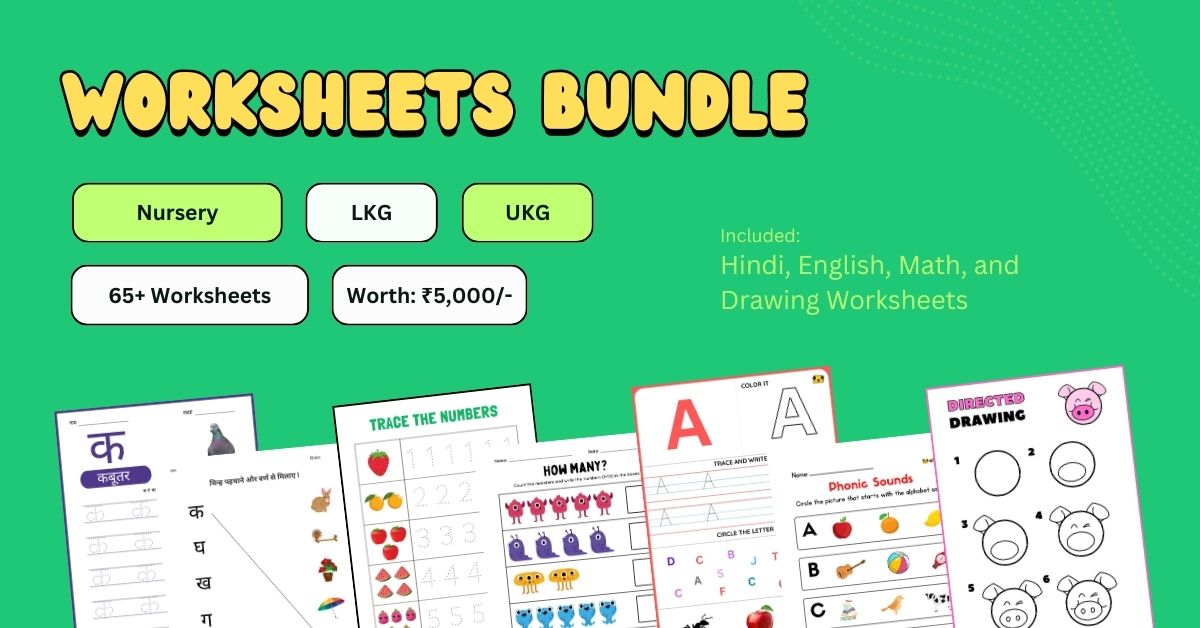
When parents search for worksheets for their children, they usually find the same thing everywhere: simple tracing sheets. A to Z tracing. 1 to 10 tracing. Repeated copying. But early childhood learning is much more than tracing lines. Children between the ages of 2 and 6 learn best when they can see, observe, match, circle, connect, and think. That is exactly why we created the Effling Kids 65+ Creative Worksheet Bundle for Nursery, LKG, and UKG. This is not just another printable pack. It is a structured preschool learning bundle designed carefully for Indian children, covering Hindi, English, Math, and Drawing, all in one place, at an affordable price of ₹299. Designed for Real Early Learning (Age 2–6 Years) The bundle begins from the toddler stage. At this age, children are not ready for heavy writing. They need movement, hand control and visual exposure. So we start with scribbling worksheets, line tracing practice, and shape-based movements. These simple activities help develop pencil grip, hand-eye coordination, and fine motor control. Before a child writes the alphabet or numbers properly, their hands must learn control, and that is where these toddler worksheets help. As children move into Nursery, LKG, and UKG, the worksheets become more structured and concept-based. Hindi Worksheets – From अ से ज्ञ to Word Recognition Hindi foundation is extremely important in the early years. That’s why this bundle includes complete Hindi worksheets from अ से ज्ञ (a se aha, k se gya). But we didn’t stop at letter recognition. Children get to match letters with pictures, circle the correct Hindi word, and practice 2-letter, 3-letter, and 4-letter Hindi words. Instead of memorizing, they start identifying. Instead of copying, they start understanding. These Hindi worksheets help build early reading skills, vocabulary, and confidence. For parents searching for Hindi worksheets for Nursery, LKG, or UKG, this bundle gives a complete, structured path. English Worksheets – Beyond ABC Tracing Most English worksheets focus only on writing capital A to Z and small a to z. While tracing is important, understanding letters and sounds is more important. This bundle includes capital letters, lowercase letters, fill-in-the-missing-alphabet activities, phonics worksheets, matching letters, and even simple word search activities for UKG level. Children learn to recognize letters, connect them with sounds, and identify words visually. Activities like “look and circle” and “match the letters” improve observation and early reading ability. Instead of mechanical writing, children develop recognition and thinking skills. Math Worksheets – Concept Before Calculation Math in early childhood should never feel stressful. It should be visual, playful, and logical. The bundle includes number tracing from 1 to 100, counting and matching activities, “how many” worksheets, number matching 1–20, reverse counting, simple addition and subtraction for UKG, and quantity-based exercises. Children learn to connect numbers with real quantities. They count objects. They match numbers. They understand before solving. This approach builds logical thinking rather than rote memorization. Drawing & Creative Worksheets, Thinking with Imagination Creativity is not separate from learning; it is part of brain development. Inside this bundle, children get alphabet coloring sheets, animal tracing worksheets, maze games, same-or-different activities, opposites worksheets, big-or-small comparisons, and connect-the-picture exercises. These activities improve focus, visual discrimination, and cognitive ability. At the same time, they keep learning fun and engaging. What Makes This Bundle Different? The biggest difference is structure. Instead of downloading random worksheets from different websites, parents get a complete learning flow from toddler to UKG in one organized bundle. It covers: All are designed for preschool children aged 2–6 years. And the entire bundle is available for just ₹299, less than the cost of a few notebooks. Who Is This Bundle For? This worksheet bundle is ideal for parents teaching at home, preschool teachers, homeschooling families, and anyone looking for creative worksheets for Nursery, LKG, and UKG. If you are searching for preschool printable worksheets, Hindi worksheets for kids, English worksheets for LKG, math worksheets for UKG, or creative drawing worksheets for kindergarten, this bundle brings everything together in one place. Final Thoughts Early learning should be interactive. It should be visual. It should help children think before they write. The Effling 65+ Creative Worksheets for Nursery, LKG & UKG are designed with that belief. Real education is not about copying letters again and again. It is about understanding. And that is where learning truly begins.
The Digital Dilemma: Balancing screens and stories
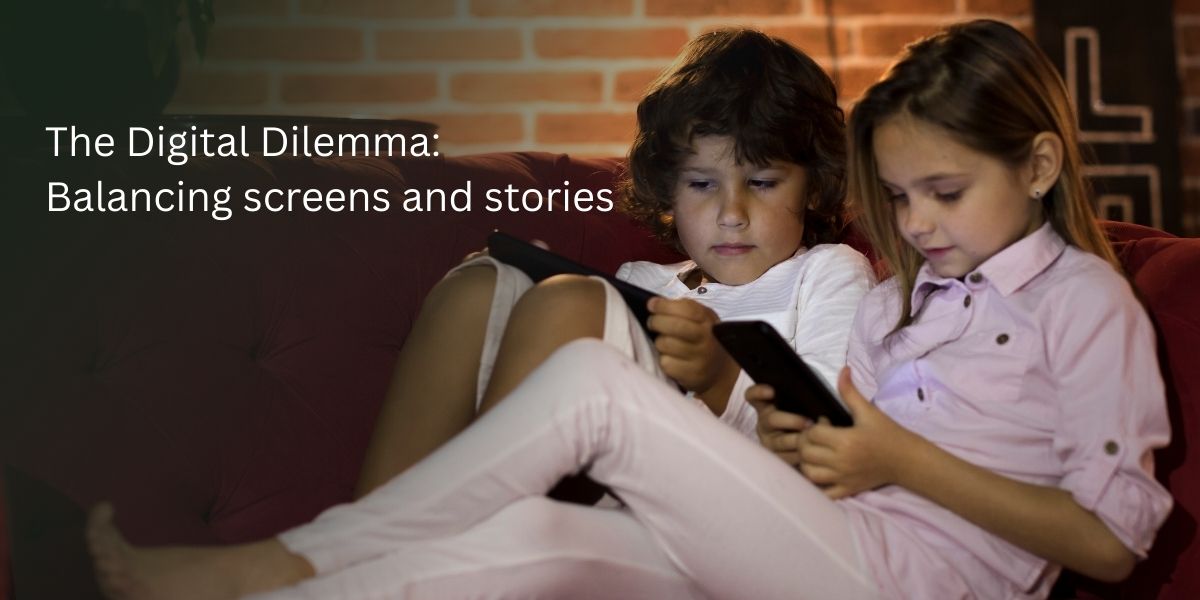
In a world increasingly gripped by technology, parenting has become more complex than ever before. Rapid changes in technology, medicine, and social expectations have created a reality vastly different from that known by earlier generations. While digital communication and globalization offer convenience and connection, they also bring new pressures that quietly shape family life. The technological revolution of the 21st century has not only altered how children learn and play, but also how parents and children relate to one another. This shift is most visible inside our homes, where screens are everywhere and undeniably convenient. A familiar question arises: should a child’s free moments be filled with screens or stories? For many parents, screens often emerge as an easy solution during moments of fatigue, work pressure, or emotional overload. They promise instant engagement and, on the surface, even educational value. Yet, when a child watches a screen, language largely flows in one direction. The screen speaks; the child listens. Even the most “educational” content rarely adapts to a child’s responses, questions, or emotions. Excessive screen time can reduce the back-and-forthconversations that are crucial for language development. Children may gradually become passive receivers of information rather than active participants in communication. Over time,this can affect attention, expressive language, and emotional connection. Recent research supports these concerns. A 2024 study by Pei Huang and colleagues provides mechanistic insights into how screen time affects social-emotional development by looking at brain network topology. The researchers used linear regression analysis to determine that infant screen time is significantly associated with specific network integrations, which in turn mediate the child’s later socio-emotional competence. Most importantly, the study found that reading with a child can significantly moderate these effects. In a world that constantly pulls children’s attention toward screens, choosing story time, even briefly, becomes a quiet but powerful act. Unlike screens, story time demands presence, patience, and interaction, resources that modern parenting often finds in short supply. It is a shared experience that invites pauses, questions, repetition, laughter, and connection. Through stories, language becomes a two-way exchange. Story time does far more than introduce new words. It helps build sentence structure, attention span, and listening skills. Through stories, children learn how conversations work(how to wait, respond, imagine, and empathise). They begin to understand emotions,relationships, and the rhythm of language. A screen may teach vocabulary, but a story teaches communication. An extensive study conducted in 2023 by Megan Gath, Bridgid McNeil, and Gail Gillon further reinforces this view. The research specifically focused on children between 3 and 5 years old, investigating how digital media consumption affects the growth andsocial bonds of preschool-aged children. The authors discovered that higher screen usage correlates with weaker language skills and diminished emotional connections with parents. The study highlights that electronic devices often replace vital activities like shared reading and direct conversation. Consequently, the time spent on tablets or televisions acts as a barrier to development by reducing the frequency of high-quality family interactions. Beyond learning, story time carries an emotional weight that screens cannot replicate. A child curled up beside a parent, listening to a familiar voice, begins to associate language with warmth and security. These moments nurture trust and attachment, foundations essential for healthy emotional development. Importantly, story time does not need to be elaborate or perfect. Even five or ten minutes of shared reading can make a difference. It can be a simple picture book, a bedtime tale, or even a story told from memory in a child’s mother tongue. What matters most is interaction, not perfection. Where Does EfflingKids Fit in This Digital Dilemma? At Effling, we believe children do not need more passive screen time; they need meaningful practice. Effling is designed as a smart notebook, not a content-watching app. Instead of scrolling or simply watching, children write, trace, draw, and practice, actively engaging their hands and minds. For ages 3–7, learning happens through repetition, movement, and joyful exploration. That’s why Effling focuses on unlimited handwriting practice, creative expression, and interactive learning, while still encouraging parents to stay involved. Technology should not replace stories or conversations. It should support practice, strengthen writing skills, and make learning enjoyable. Because a screen can show letters.But a child grows when they write them. By Dr. Mehnaz RashidPhD Linguistics
Raising Readers: How Parents Can Inspire a Lifelong Love of Books

Reading is a powerful gift that all children deserve. Before children can decode words independently, being exposed to stories and language through books begins to shape how they communicate, think and interpret the world. When children form a love for reading in their early years, they gain benefits that extend beyond the classroom. The Benefits of Children ReadingReading supports cognitive development for children in several ways. When children read or are read to, they are actively building neural connections in their brains that support comprehension, language and their memory. Exposure to stories through reading helps expand vocabulary, strengthen listening skills and improve sentence structure. Having these language foundations equips children for later academic success. Beyond skills in literacy, reading also promotes imagination and creativity. Through books, children are able to encounter different worlds, experiences and characters that they would not normally encounter in their daily lives. This engagement helps children to develop creative thinking, problem-solving abilities and curiosity, especially when accompanied by additional learning experiences to extend the themes of the book. Reading also plays a pivotal role in social and emotional development. Books and stories often explore feelings, relationships, challenges and moral decisions. As children follow characters through these experiences, they develop their understanding of empathy and understanding alternative perspectives. A child who is exposed to reading is also exposed to diverse cultures and views, helping them to have a broader understanding of the world around them. An additional benefit is the development of focus and concentration. In a world that is increasingly filled with digital content that is often fast-paced, reading encourages children to engage deeply with a story while slowing down. Reading stamina strengthens the ability to concentrate for longer periods and supports learning across all subjects. Reading is often the gateway to accessing the curriculum in the classroom, with children who are unable to read yet facing barriers and a higher cognitive load at school. Reading can become a lifelong source of enjoyment when children associate books with comfort and curiosity. Children who associate books with positive emotions are more likely to continue reading into adolescence and adulthood, supporting ongoing learning and intellectual growth. How Parents Can Engage Their Child in Reading at HomeParents play an important role in shaping their children’s relationship with books. Home environments can either nurture a love for reading or make it a chore. Fortunately, there are a number of ways that parents can encourage reading in enjoyable ways. One of the most effective strategies is reading aloud together, with even older children benefiting from being read to. Hearing a parent’s or loved one’s voice bring stories to life creates positive emotional connections with books. This also exposes children to richer and more complex vocabulary than they might be able to access themself. Making reading an interactive experience can also increase engagement. Parents can pause during the story to ask questions such as “What do you think will happen next?” or “Why do you think the character did that?” These conversations help children think critically about what they are reading to deepen comprehension. Choice is another vital factor. Children are far more likely to read when they feel ownership over their book selection. Parents can offer a variety of options, such as picture books, comics, graphic novels, informational texts, and chapter books, to allow children to explore topics that genuinely interest them. A child who is fascinated by dinosaurs, space, animals, or sports will naturally gravitate toward books that reflect these topics. From my personal experience as a teacher, ‘pushing’ children to challenge themselves may reflect academically; however, if this is at the cost of their love of reading it can have more detrimental long-term effects. When borrowing from the school library, I encourage my students to choose one book that will challenge them to become a better reader, and another book that will help them to love being a reader. This choice provides guidelines whilst also allowing children authority over their learning and journey as a reader. Parents can also model positive reading habits by showing reading as a valued and enjoyable activity. Parents can do this by reading regularly, whether from books, newspapers or magazines. Parents modelling an enjoyment for reading sends the powerful message to children that they can also read in this way. Creating a comfortable environment to read in at home can also support children in developing their love for reading. Through creating a cosy reading nook with a small basket of books, or a bookshelf that rotates with the seasons and time of year, reading can become accessible and exciting for children. Connecting reading to everyday life helps children to understand its practical value. Through reading recipes whilst cooking, instructions for games, signs on the road or whilst travelling, or information about a topic of interest, reinforces that reading is not just a school activity, but a part of all of life. Practical Tips to Build a Daily Reading RoutineEstablishing consistent reading routines at home helps transform reading from an occasional academic activity into a natural daily habit. As with many routines for children, consistency and simplicity are key. You may begin by choosing a regular reading time each day. Bedtime can often work well for many families as it provides a calm, comfortable and connected activity before sleep. Reading for 10-15 minutes each night can make a meaningful impact over time.As previously mentioned, creating a comfortable reading space for the child to relax and focus is another effective method. Perhaps provide a quiet corner with pillows, a reading chair, or snuggling on the couch. As parents, it can be tempting to challenge children; it is important to keep expectations realistic. Building enjoyment is the goal, not pressure. There may be some days when children are eager to read a lot, and others when they might only want to read a few pages. The most important thing is to maintain the habit of reading. Parents may also choose to incorporate a ‘read alone, read… Continue reading Raising Readers: How Parents Can Inspire a Lifelong Love of Books