
In a world increasingly gripped by technology, parenting has become more complex than ever before. Rapid changes in technology, medicine, and social expectations have created a reality vastly different from that known by earlier generations. While digital communication and globalization offer convenience and connection, they also bring new pressures that quietly shape family life. The technological revolution of the 21st century has not only altered how children learn and play, but also how parents and children relate to one another.
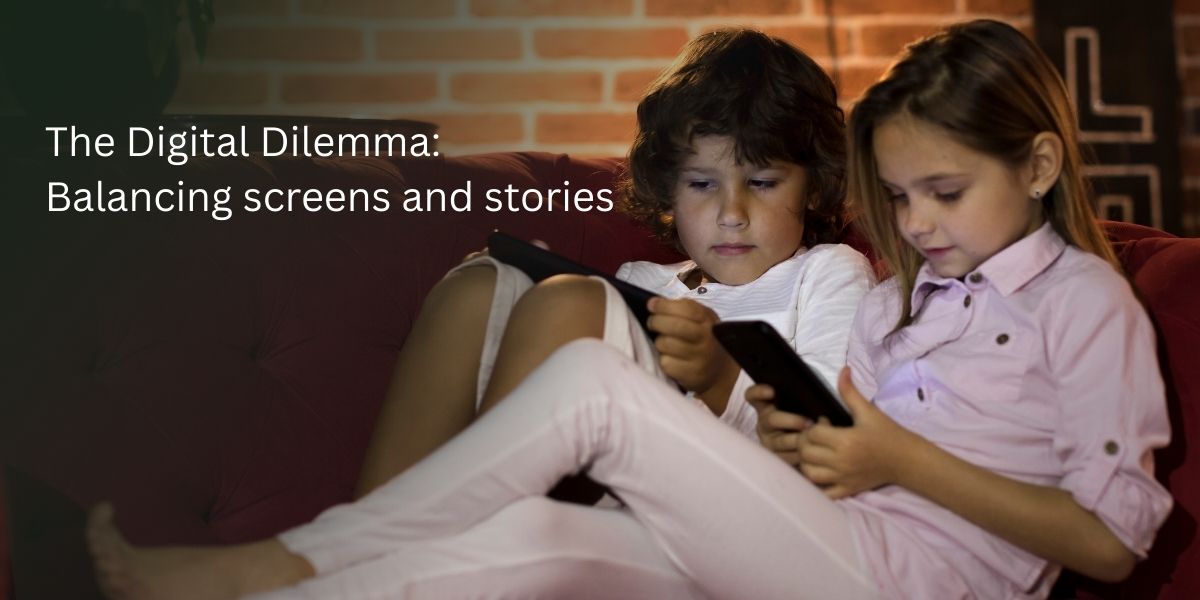
This shift is most visible inside our homes, where screens are everywhere and undeniably convenient. A familiar question arises: should a child’s free moments be filled with screens or stories? For many parents, screens often emerge as an easy solution during moments of fatigue, work pressure, or emotional overload. They promise instant engagement and, on the surface, even educational value.
Yet, when a child watches a screen, language largely flows in one direction. The screen speaks; the child listens. Even the most “educational” content rarely adapts to a child’s responses, questions, or emotions. Excessive screen time can reduce the back-and-forth
conversations that are crucial for language development.
Children may gradually become passive receivers of information rather than active participants in communication. Over time,
this can affect attention, expressive language, and emotional connection. Recent research supports these concerns. A 2024 study by Pei Huang and colleagues provides mechanistic insights into how screen time affects social-emotional development by looking at brain network topology.
The researchers used linear regression analysis to determine that infant screen time is significantly associated with specific network integrations, which in turn mediate the child’s later socio-emotional competence. Most importantly, the study found that reading with a child can significantly moderate these effects.
In a world that constantly pulls children’s attention toward screens, choosing story time, even briefly, becomes a quiet but powerful act. Unlike screens, story time demands presence, patience, and interaction, resources that modern parenting often finds in short supply.
It is a shared experience that invites pauses, questions, repetition, laughter, and connection. Through stories, language becomes a two-way exchange.
Story time does far more than introduce new words. It helps build sentence structure, attention span, and listening skills. Through stories, children learn how conversations work(how to wait, respond, imagine, and empathise). They begin to understand emotions,
relationships, and the rhythm of language. A screen may teach vocabulary, but a story teaches communication.
An extensive study conducted in 2023 by Megan Gath, Bridgid McNeil, and Gail Gillon further reinforces this view. The research specifically focused on children between 3 and 5 years old, investigating how digital media consumption affects the growth and
social bonds of preschool-aged children. The authors discovered that higher screen usage correlates with weaker language skills and diminished emotional connections with parents.
The study highlights that electronic devices often replace vital activities like shared reading and direct conversation. Consequently, the time spent on tablets or televisions acts as a barrier to development by reducing the frequency of high-quality family interactions.
Beyond learning, story time carries an emotional weight that screens cannot replicate. A child curled up beside a parent, listening to a familiar voice, begins to associate language with warmth and security. These moments nurture trust and attachment, foundations essential for healthy emotional development.
Importantly, story time does not need to be elaborate or perfect. Even five or ten minutes of shared reading can make a difference. It can be a simple picture book, a bedtime tale, or even a story told from memory in a child’s mother tongue. What matters most is interaction, not perfection.
Where Does EfflingKids Fit in This Digital Dilemma?
At Effling, we believe children do not need more passive screen time; they need meaningful practice.
Effling is designed as a smart notebook, not a content-watching app. Instead of scrolling or simply watching, children write, trace, draw, and practice, actively engaging their hands and minds.
For ages 3–7, learning happens through repetition, movement, and joyful exploration. That’s why Effling focuses on unlimited handwriting practice, creative expression, and interactive learning, while still encouraging parents to stay involved.
Technology should not replace stories or conversations. It should support practice, strengthen writing skills, and make learning enjoyable.
Because a screen can show letters.
But a child grows when they write them.
By Dr. Mehnaz Rashid
PhD Linguistics
